| CAD366 | Advanced Computer Aided Design for Electronics | In-person | In-person | In-person |
| | This course provides students with an introduction to Computer Assisted Design (CAD) software with a particular emphasis on mechanical design using Autodesk Fusion 360. Students will learn to create complex 3D models based on 2D drawings using a series of modifying tools. Students will also learn about related mechanical design topics such as material selection, manufacturing techniques, and fastener selection. There will also be additional coverage of advanced PCB design topics such as creepage/clearance, ground planes, and the use of connectors. A final team project in the course will combine mechanical design and PCB design techniques into one comprehensive design from start to finish. Students will emerge from the course with a broad understanding and practical skills in practical mechanical design and PCB design. |
| COM455 | Communications Fundamentals | In-person | In-person | In-person |
| | This course provides students with an introduction to the physical layer of communication technology focusing on time and frequency domain analysis of baseband and modulated signals. Students will learn to locally and remotely control power supplies, signal generators, oscilloscopes and spectrum analyzers as well as to perform automated test and measurement for capture and analysis of test data. Data will be generated, organized and analyzed using Excel and Electronic Design Automation (EDA) tools. Students will also be introduced to fiber optic communication technology. Students emerge with a sound understanding of communication technology and a suite of practical industry-ready skills. |
| CSF453 | Control Systems Fundamentals | In-person | In-person | In-person |
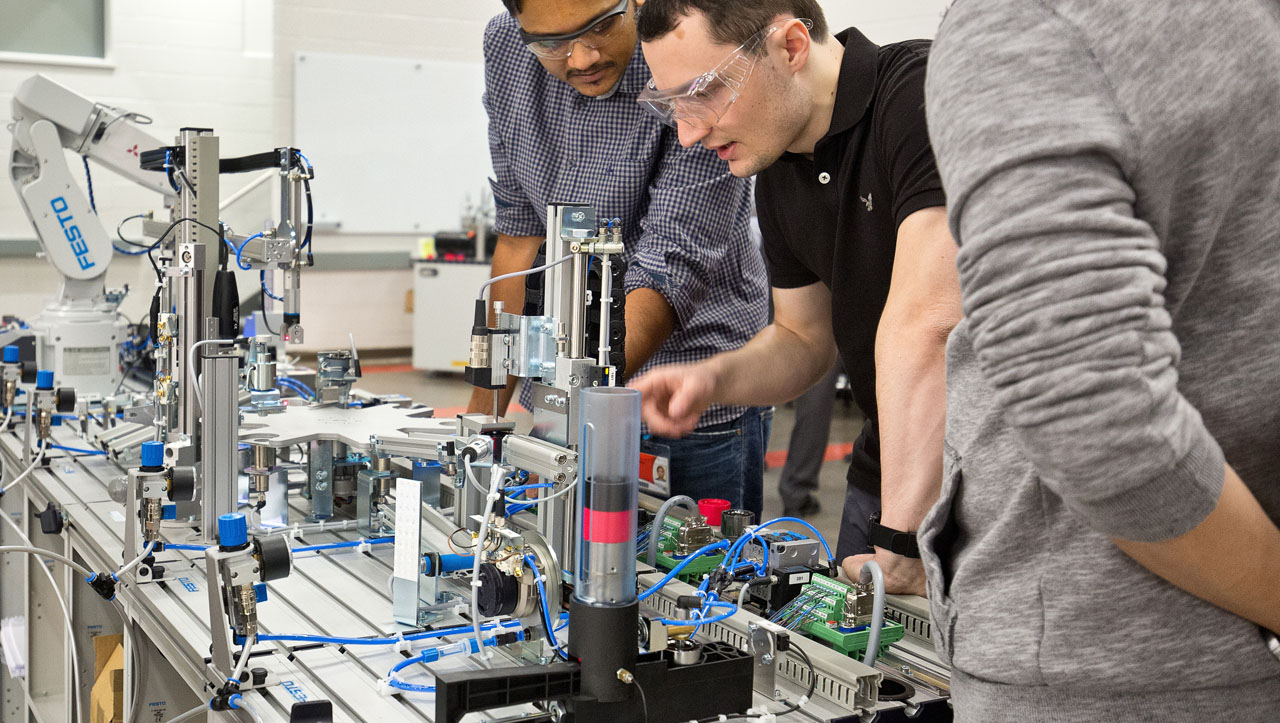
| | This course covers the fundamentals of control systems. It covers the basic principles for designing and controlling simple mechanical, electrical and fluid systems. The fundamental concept of control system theory is covered. The course introduces various control systems including programmable logic controllers (PLCs) in a complex mechatronic system. Examples are given using the automation system SIMATIC S7 and the related programming software TIA portal/STEP7. Using computer simulation, students will learn the role the control system (PLC) plays within a mechatronic system or subsystem. They will also learn basic elements of PLC functions by writing small programs and testing these programs on an actual system (2 axis gripper pick and place unit). Students will learn to identify malfunctioning PLCs hardware, as well as to apply troubleshooting strategies to identify and localize problems caused by PLC software. |
| ELD255 | Semiconductor Devices | In-person | In-person | In-person |
| | This course provides an introduction to the electronic devices at the heart of all modern technology. It explores characteristics, principles and applications for diodes (rectifier, Zener and LED), transistors (BJT, FET and MOSFET) and operational amplifiers (Op-amps). This is a strongly lab-centric course, with lectures focusing on the support of hands-on lab work. Circuit analysis and design are aligned with Electronic Design and Automation (EDA) flow principles including schematic capture, circuit SPICE simulation (with OrCAD), prototyping, and test and measurement. Students learn how to analyze, design, build and troubleshoot a variety of circuits including rectifier circuits, power supplies and voltage regulators, transistor switches, Common Emitter (CE) amplifiers, and open and closed loop Op-amp circuits. A lab project draws together the key elements from this course. Students emerge with comprehensive and practical hands-on experience in basic electronic device analysis and design which provides a foundation for subsequent studies. |
| HSI266 | Hardware Software Integration | In-person | In-person | In-person |
| | This course explores the integration of electronics systems through methods of hardware interfacing and software programming. Students will build upon their knowledge of simple DC circuits, digital systems, CAD design, and C programming by examining the principles and applications for circuit designs containing more advanced components, such as pushbuttons, transistors, various sensors, buzzers, speakers, DC and servo motors, and operational amplifiers and then utilizing these concepts in the lab. The circuits will be modified to interface with a data acquisition unit programmed in C language. Additionally, students will be introduced to IoT fundamentals that integrates web publishing with their circuits and programs. The lab project draws together the key elements from this course. Students emerge with comprehensive and practical hands-on experience in electronic device integration, which combines their prior semesters learning and prepares students for their capstone projects. |
| MIR355 | Microcomputer Repair | Hybrid
In-person | Hybrid
In-person | Hybrid
In-person |
| | The course provides students with a comprehensive overview of microcomputer hardware and software. Upon completion of the course, the student will acquire a solid foundation in microcomputer concepts, including defining hardware components, installing and configuring operating systems, networking concepts, virtualization, and troubleshooting techniques. |
| WTP100 | Work Term Preparation | Online | Online | Online |
| | This Work Term Preparation course is designed to empower students with the tools, skills, and strategies needed to navigate the modern job market and achieve long-term career success. Through self-assessment, career exploration, helping students to identify and leverage skills from their existing experiences, students will develop a deep understanding of their personal strengths, values, personality, interests and goals. The course covers essential topics such as crafting professional résumés and cover letters, mastering interview techniques, and building a strong personal brand, including an online presence. Students will learn how to research career pathways, evaluate job market trends, and create actionable career plans tailored to their aspirations. Emphasis is placed on professional communication, networking, workplace readiness, and adapting to diverse organizational cultures. Additionally, the course provides insights into negotiating job offers, managing career transitions, and professional growth. With a focus on lifelong learning and continuous improvement, this course equips students with the confidence and resources to pursue fulfilling careers while remaining adaptable in a dynamic and competitive workforce. Ideal for students preparing to enter the job market or those seeking to refine their career trajectory, this course fosters self-awareness, professional readiness, and strategic career planning. |
| WTP100 - Work-Integrated Learning option only |